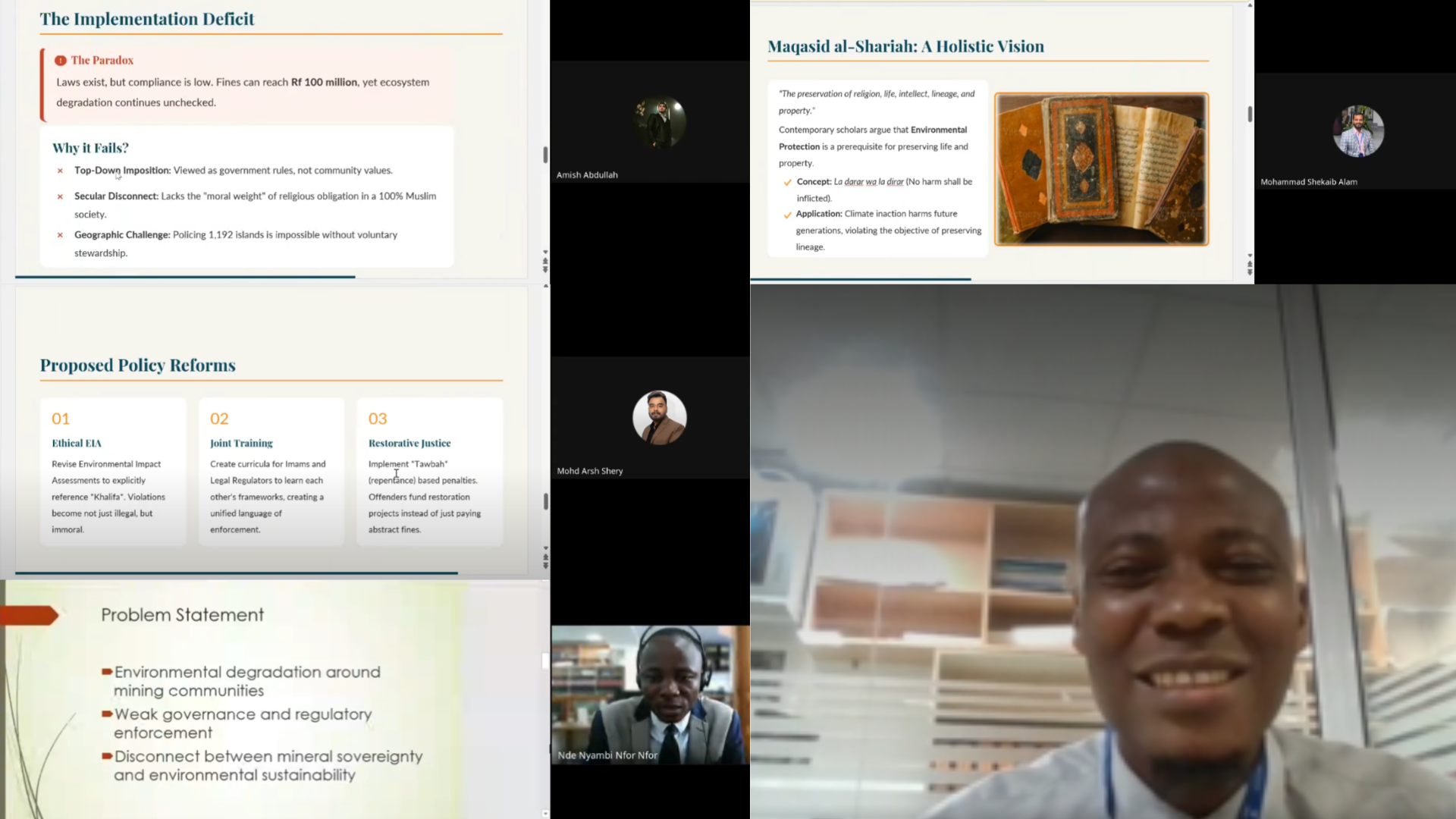
The Faculty of Shariah and Law at Villa College marked a significant milestone in environmental legal scholarship on 10 December 2025 with the successful conclusion of the International Climate Change Law Conference. Organised by the Centre for Transformative Environmental and Marine Law, this virtual gathering brought together leading academics, legal practitioners, and policy experts from across the globe to examine one of the most critical questions of our era: how can law effectively respond to the escalating climate crisis?
The conference theme, "Climate Change in the Age of Change and the Transformative Environmental Rule of Law: Where Are We and Where Are We Going?", reflects the dual challenge facing the international community today. We are simultaneously navigating rapid environmental deterioration whilst witnessing unprecedented shifts in global governance structures, technological capabilities, and social consciousness. This confluence demands legal frameworks that are not merely reactive but genuinely transformative in their approach to environmental protection and climate justice.
The collaborative nature of this conference underscores the necessity of international partnership in addressing climate challenges. Villa College worked alongside distinguished institutions including the National Center for the Law of the Sea and Maritime Law at Ankara University in Türkiye, Gujarat National Law University in India, the Environmental Law Unit of the University of the West Indies in Barbados, and Parley Maldives. This diversity of perspectives enriched the discourse considerably, bringing together expertise from various legal traditions, geographical contexts, and institutional frameworks.
A particularly meaningful aspect of the conference was its deliberate alignment with three significant observances: Maldives Fisheries Day, Multilateral Environmental Agreements Day, and Human Rights Day. This strategic positioning emphasised an essential truth often overlooked in climate discourse, that environmental degradation, resource management, and human rights are inextricably linked. The United Nations Office on Drugs and Crime contributed to this multi-dimensional discussion through a special presentation by Mr Mohammenul Islam on fisheries crime, illuminating how illegal activities undermine not only marine ecosystems but also governance structures and the rule of law itself. These connections remind us that climate action cannot be pursued in isolation from broader questions of sustainability, equity, and justice.
The conference featured two exceptional keynote addresses that provided both theoretical depth and practical insight. Professor Henk Addink of Utrecht University in the Netherlands delivered a compelling presentation on environmental principles in the context of climate change, with particular emphasis on the precautionary principle. His argument that core environmental law principles remain essential legal responses to rapidly evolving and uncertain climate emergencies resonates strongly with the Maldivian context, where the consequences of inaction could prove catastrophic. The precautionary principle, which advocates for preventive action in the face of uncertainty, becomes especially relevant for Small Island Developing States that face existential threats from climate change.
Professor Andi Arsana of Gadjah Mada University in Indonesia complemented this discussion by examining the intersection of international law of the sea and climate change challenges confronting island nations. His keynote address, "Sea Level Rise and the Challenge of Climate Change in Island Nations," explored questions that strike at the heart of sovereignty and territorial integrity for countries like the Maldives. As sea levels rise, what happens to maritime boundaries, exclusive economic zones, and the very definition of statehood? These are not abstract legal questions but matters of national survival for many island communities. Professor Arsana's expertise helped participants navigate the complex legal, territorial, and maritime implications of these unprecedented challenges.
Dean Uza Asna Ahmed articulated the urgency of this work in her opening remarks, describing climate change as one of the most pressing challenges of our time and reaffirming the critical role of law in shaping effective and just responses. Her vision for the conference extended beyond the event itself, noting the Faculty's intention to publish the conference outcomes alongside selected full papers from the 2024 conference in a high-impact academic journal. This commitment to rigorous scholarship ensures that the insights generated through these discussions will contribute to the broader body of knowledge informing climate law and policy.
One of the most thought-provoking sessions focused on the recognition of ecocide and its prospects in the Maldives. Moderated by Mr Abdulkareem Azeez, Chair of Firdaus International in Nigeria, and Dr Muhammed Shekeib, an Assistant Professor at the Faculty of Shariah and Law, this panel discussion brought together Dr Nyambi Nfor Nfor, Mr Muhammad Arsh, and Dr Tajudeen Sanni to examine whether severe environmental destruction should be recognised as a crime under international law. The concept of ecocide, which would criminalise mass environmental damage and destruction, represents a potentially transformative approach to environmental protection. For the Maldives, whose very existence is threatened by climate change, the recognition of ecocide could provide crucial legal mechanisms for accountability and redress. The panellists offered critical insights into the legal, normative, and policy dimensions of this emerging area of law, exploring both the opportunities and challenges of incorporating ecocide recognition into the Maldivian legal framework.
The international character of the conference was evident in its diverse participant base, with attendees joining from the Maldives, Uganda, New Zealand, the Netherlands, Cyprus, Nigeria, Romania, Germany, Türkiye, Indonesia, India, and the United Kingdom, among other nations. This geographical breadth reflects the universal nature of climate challenges whilst acknowledging that impacts and responses vary significantly across different contexts. The exchange of perspectives between scholars and practitioners from developed nations, Small Island Developing States, and emerging economies enriched the quality of discussion and fostered a more nuanced understanding of global climate governance.
Student engagement formed another vital component of the conference through an essay competition centred on "The Right to a Clean Environment in the Context of Climate Change in the Maldives." This initiative recognises that today's students will be tomorrow's legal practitioners, policymakers, and environmental advocates. By encouraging young scholars to grapple with these complex issues, Villa College is investing in the next generation of climate leaders and ensuring that fresh perspectives and innovative thinking continue to shape environmental law discourse.
As Dr Tajudeen Sanni, Associate Professor and Chair of the Organising Committee, noted in his closing remarks, the conference represents not an endpoint but a beginning. His call to action for sustained scholarly engagement and policy-oriented responses to climate change acknowledges that academic conferences must translate into concrete outcomes. The planned publication of conference outputs will help ensure that the insights generated during these discussions reach wider audiences and inform ongoing debates in both academic and policy circles.
The success of this conference reflects Villa College's growing reputation as a hub for environmental law scholarship in the Maldives and the wider region. The Centre for Transformative Environmental and Marine Law has established itself as a vital institution for advancing legal responses to environmental challenges, and events such as this conference demonstrate the value of sustained investment in academic excellence and international collaboration. As the Maldives continues to advocate for ambitious climate action on the global stage, institutions like Villa College provide the intellectual foundation for evidence-based policy and principled legal argument.
Looking forward, the themes explored at this conference will only become more pressing. Sea level rise continues unabated, extreme weather events grow more frequent and severe, and the window for preventing catastrophic climate change narrows with each passing year. The legal frameworks discussed at this conference, from the precautionary principle to maritime law to ecocide recognition, represent essential tools for responding to these challenges. However, principles and frameworks alone are insufficient without political will, adequate resources, and sustained commitment to implementation.
The conference also highlighted the particular vulnerability and agency of Small Island Developing States in global climate governance. Whilst these nations contribute minimally to global greenhouse gas emissions, they face disproportionate impacts from climate change. This injustice demands legal mechanisms that ensure accountability, provide for adaptation and loss and damage, and recognise the rights of affected communities. The Maldives, through its diplomatic leadership and through scholarly contributions from institutions like Villa College, continues to amplify these concerns and push for more ambitious and equitable climate action.
Villa College extends its gratitude to all keynote speakers, panellists, moderators, and participants who contributed to the richness of discussion and the success of this conference. The collaboration between international partners, the expertise shared by distinguished academics, and the engagement of students and practitioners created an environment conducive to meaningful dialogue and knowledge exchange. As we move forward with plans for publication and continued research, we remain committed to advancing transformative environmental law and contributing to global efforts to address the climate crisis through robust legal frameworks, innovative thinking, and unwavering dedication to justice and sustainability.