On 1 May 2026, Villa College joined a coalition of partners, among them Transparency Maldives, the Human Rights Commission, the Maldives Red Crescent, and Bharat Club, to support a Migrant Workers Wellbeing Camp held at the football stadium near Supreme Mart in Thilafushi. Organised in conjunction with International Labour Day, the camp was designed to bring accessible services and information directly to migrant workers and to promote their rights and overall welfare. The initiative offers a clear example of how coordinated effort across sectors can address needs that no single organisation could meet alone.
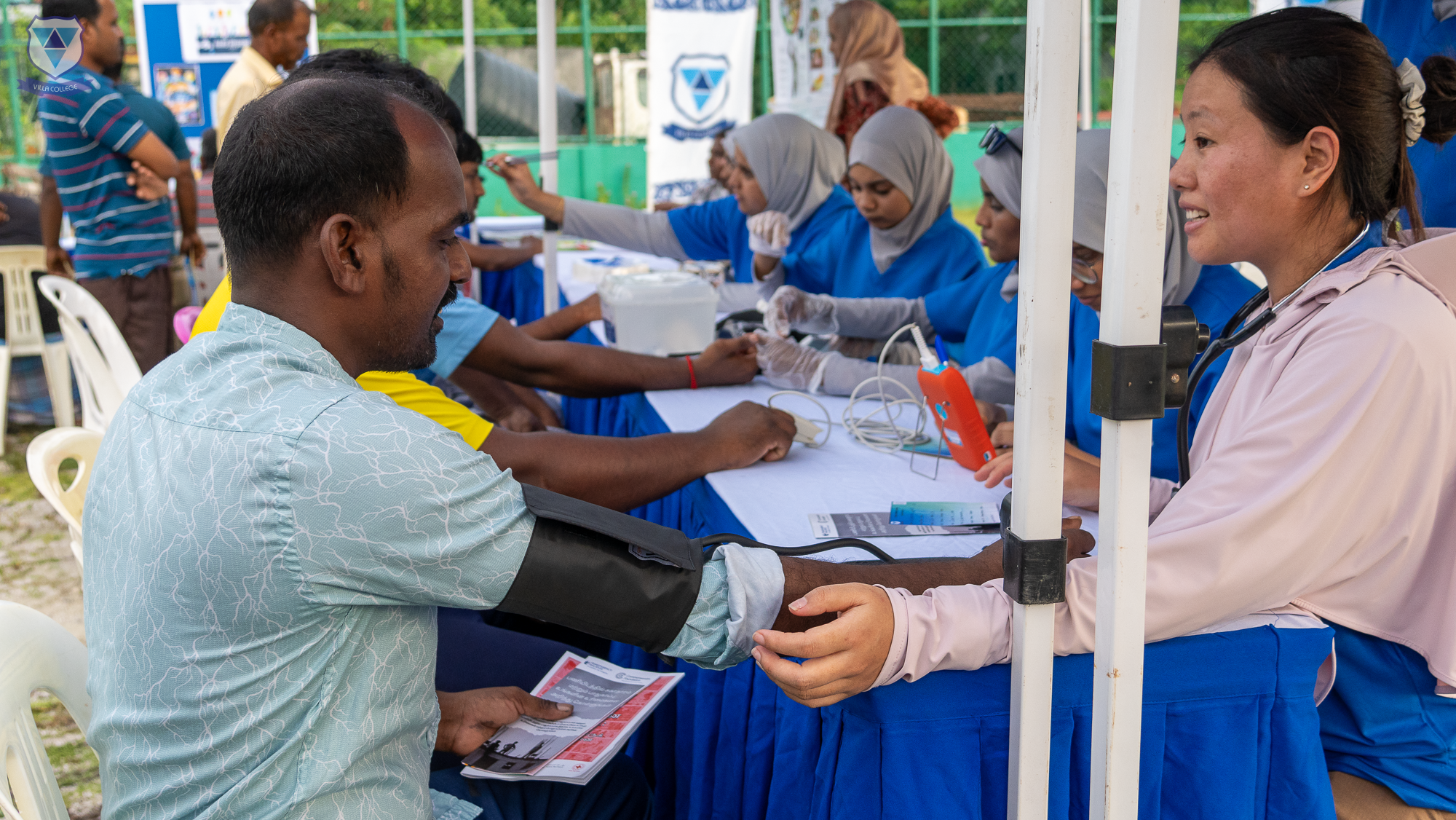
One of the defining features of the camp was its multi-partner, multi-service model. Rather than focusing on a single intervention, the participating organisations offered a range of free services that included health check-ups, legal services, and environmental awareness activities, each tailored to the realities faced by migrant workers in the Maldives. Volunteers and professionals were present throughout the afternoon to listen, advise, and direct participants towards appropriate support mechanisms. This breadth matters because migrant workers' challenges rarely fall into neat categories, and an integrated approach is far more effective than addressing health, legal, and environmental concerns in isolation.
A second theme central to Villa College's involvement was its student-centred, experiential approach. Law students provided legal information and rights awareness under the supervision of lecturers Advocate Amish Abdullah and Mohd Arsh Shery, working alongside Uza. Alsan Sadiq of Transparency Maldives, while Dr Shekaib Alam supervised field survey activities that helped students document key issues and needs to inform future research and advocacy. In parallel, students from the Faculty of Health Sciences contributed to the health dimension under the guidance of Dr Monica Arora, Karthiga Raghupathy, and Koneino Peseyie, assisting with basic health checks, sharing preventive health information, and helping participants navigate local health resources. The arrangement allowed students to apply academic knowledge in a genuine setting, which tends to deepen learning in ways that classroom study alone cannot replicate.
Taken together, the camp illustrates a wider insight worth noting for institutions and organisations engaged in social impact work. Meaningful community contribution and practical education need not be separate pursuits, and when carefully structured they can reinforce one another. For Villa College, the engagement reflects an ongoing commitment to community engagement, experiential learning, and social justice, demonstrating how a higher education institution can stand alongside civil society partners to advance access to justice, health, and environmental awareness for migrant communities in the Maldives.