Systematic Measurement and Tracking
Villa College has established comprehensive, well-structured tracking processes to ensure continuous monitoring of female academic success
Continuous Monitoring Cycle:
Key indicators such as application, enrolment, retention, and graduation rates for women are regularly monitored across all programmes. The Registration Department provides updated insights each semester during the Week 7 census week, enabling the College to identify retention or success patterns promptly and take timely action.
Detailed Annual Reporting:
Each year, during the graduation period, the Registration Department produces a comprehensive report detailing gender-specific metrics on all graduates (Level 7 and above). This process involves collaboration with academic faculties to generate and verify detailed graduate lists, ensuring accuracy.
Formal Governance Review:
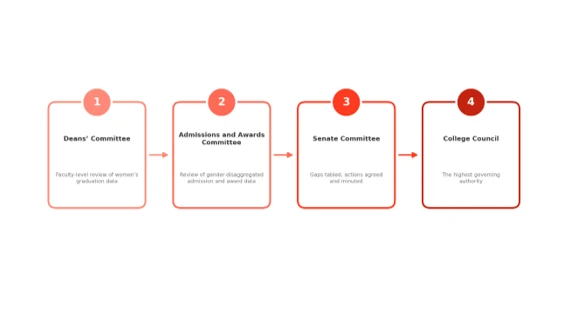
The tracking mechanism is formalized through rigorous governance stages where data on women’s graduation rates is thoroughly examined:
At each stage, strategic action plans are formulated to address any identified gaps, ensuring equitable outcomes across all programmes.
Dashboard-Based Tracking of Gender and Graduation
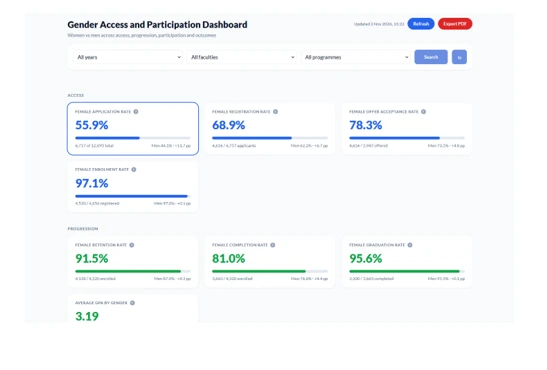
Gender-related indicators are tracked continuously through dashboards rather than only at the end of the year. The Gender Access and Participation Dashboard follows women from application to graduation, with retention, completion and graduation rates and average GPA by gender, filterable by faculty, programme and year. The figures and visuals in this section are drawn from these dashboards, so the numbers that inform Senate discussions are the numbers reported here.
Evidence of Graduation Success and Gap Closure (2025 Data):
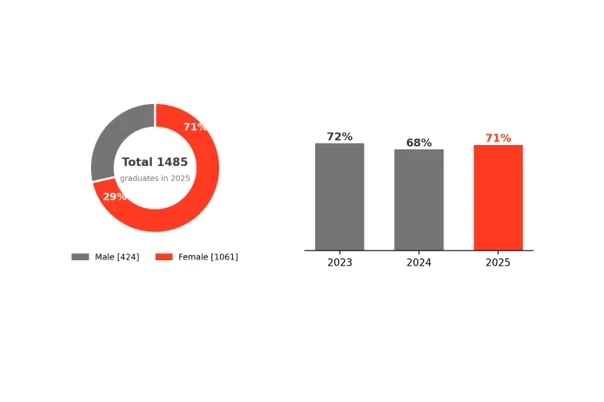
In 2025, 1,485 students graduated, up from 1,057 in 2024 (+40.5%). Of these, 1,061 (71%) were women, compared with 724 (68%) in 2024, so the number of female graduates grew by 46.5%, faster than the cohort as a whole. The share of degrees awarded to women has recovered from 68% in 2024 to 71% in 2025, close to the 72% recorded in 2023.
Discipline-Specific Success (Closing the Gap):
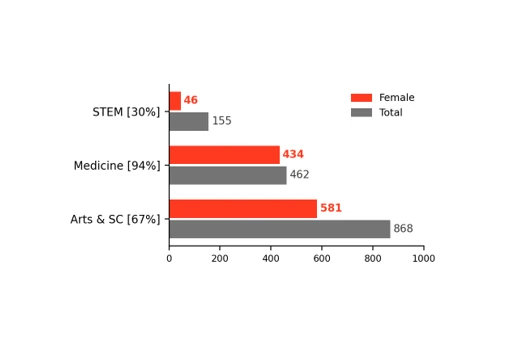
The chart below shows female graduates against total graduates in each subject domain in 2025, in the same format as last year’s report.
STEM:
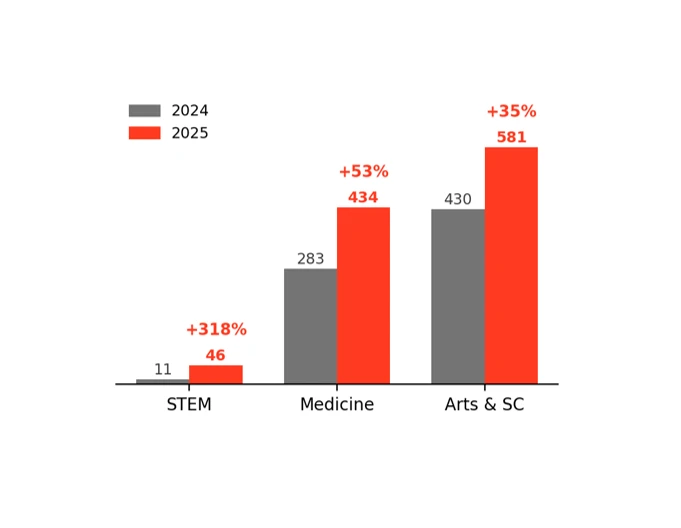
46 of 155 graduates (29.7%) were women, compared with 11 of 71 (15.5%) in 2024. The number of STEM graduates more than doubled (+118%) and the number of female STEM graduates more than quadrupled (+318%), closing a large part of the gap.
Arts & Humanities / Social Sciences:
581 of 868 graduates (67%) were women, compared with 430 of 693 (62%) in 2024. The number of female graduates increased by 35%.
Medicine:
434 of 462 graduates (94%) were women, compared with 283 of 293 (97%) in 2024. The number of female graduates increased by 53%. The female share edged down because male graduates rose from 10 to 28, while the number of women graduating continued to grow strongly.
Growth in Female Applications and Registrations:
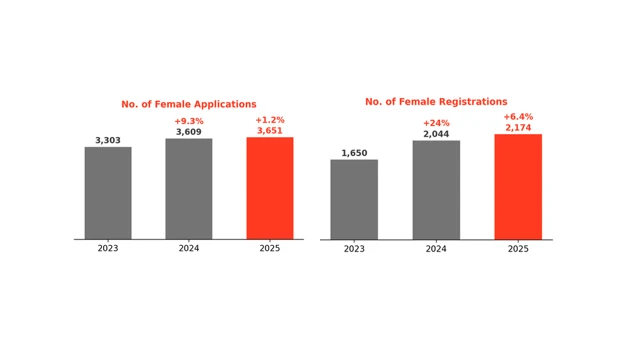
In 2025, female participation increased, with 3,651 women applying (62.2% of all applicants) and 2,174 women registering (62.1% of all registered students). This represented a 1.2% increase in female applications and a notable 6.4% increase in female registrations compared to the previous year. Crucially, the registration rate among female applicants were maintained from 2024 to 2025 as 62%, demonstrating that the College's strategies are effectively converting interest into enrollment.
Schemes Driving Success and Addressing Disparity
These achievements reflect the clear effectiveness of targeted initiatives designed to raise awareness, build capacity, and ensure women successfully persist to graduation by addressing financial, professional, and academic barriers.
Targeted Mentoring and Capacity Building (Non-Financial Support)
These programs provide essential professional guidance and soft skills that boost confidence and persistence among female students, directly supporting their ability to complete challenging programs:
The Centre for Innovation and Entrepreneurship Development (CIED) maintains a specific wing for mentoring women in the STEM domain. This mentorship is conducted in collaboration with academic units, industry experts, and associations such as Women in Tech Maldives.
"Women in Law" Panel: Collaboration with the Maldives Bar Council featured prominent female legal leaders (Supreme Court Justice, JSC President, First Female Lawyer) to inspire and mentor students.
Faculty Leadership: Female faculty, such as Uza. Asna Ahmed (Dean) and Amish Abdullah (Lecturer), delivered keynote speeches and chaired sessions at the International Conference on Women's Rights, showcasing female academic leadership to students.
EveryWoman Campaign Sessions: Partnership with Moms Aid and local councils to conduct parenting ("Tharubiyyathu") and Legal Aid sessions, reducing external social barriers that commonly interrupt women's studies.
Financial and Industry Support (Reducing Economic Barriers)
These schemes reduce the financial strain that can lead to withdrawal, particularly for women pursuing rigorous or underrepresented programs:
STEM & Healthcare Equity Scholarship: Explicitly targets female students for scholarships in underrepresented subjects like Computer Science and Engineering.
TTH Nursing Scholarship Programme: A long-term, high-impact collaboration with Tree Top Hospital and the Maldivian Nurses Association (MNA) provides full scholarships, guaranteeing access and financial stability for female students in this health sector.
Flexible Payment Options: The Finance Department grants flexible payment structures upon request, minimizing the risk of drop-out due to temporary financial constraints.
Enabling Academic Flexibility (Retention and Persistence):
These procedural accommodations directly address the unique life challenges of female students, such as motherhood and family care, ensuring they can persist through to graduation:
Personal Circumstance Procedure: Allows for easy provision for students needing flexible arrangements, such as switching to online learning for recent mothers or those with high-risk pregnancies, directly preventing withdrawal.
Timetable Adjustments: Class schedules, particularly for Nursing students (a high-female enrollment field), are arranged considering their professional
duty hours and family responsibilities, supporting long-term retention of working women.
Bridging Programs: The college’s three intake structure and foundation-to-degree bridging pathways offer necessary flexibility in entry and timing, accommodating women who must manage complex personal schedules alongside their studies.
By meticulously tracking graduation rates and consistently applying these multifaceted schemes across financial aid, professional mentoring, and academic flexibility, Villa College ensures it has a robust mechanism to not only measure success but proactively close any existing gender gap in graduation likelihood.