Institutional Expertise in National Policy, Regulatory Governance, and Public Service
Expert Participation in National Healthcare Governance and Professional Regulation
Villa College's Faculty of Health Sciences contributes to healthcare governance through staff participation in national councils and specialist committees. Ms. Aishath Mala, Dean of the Faculty of Health Sciences, holds several advisory and professional responsibilities, including membership of the Maldives Nursing and Midwifery Council (MNMC), the National Antimicrobial Resistance Coordination Committee, the MNMC Trust Fund Committee and the National Palliative Care Steering Committee. She additionally serves as a Clinical Examiner for Nursing under the MNMC. These appointments bring nursing education and clinical expertise into regulatory and policy discussions concerning professional competency standards, the quality and safety of nursing services, antimicrobial resistance, stewardship of professional resources and the development of compassionate palliative care. Her clinical examination responsibilities also support national mechanisms for assessing the professional readiness and competence of nurses.
Contributions to National Legal Standards, Bar Examination Reform and Regulatory Assessment
Villa College supports the development of legal professional standards, fair assessment practices and regulatory quality assurance through the participation of its staff in national expert bodies. Uza. Asna Ahmed, Dean of the Faculty of Shariah and Law, serves as a member of the Bar Examination Committee of Experts, contributing legal subject-matter expertise relevant to the assessment of professional knowledge and competence required for admission to legal practice in the Maldives. Such participation strengthens connections between legal education, professional licensing and national standards for the legal profession.
Mr. Moosa Mohamed Manik, Director of the Institute for Academic Development (IAD), has undertaken a consultancy role as Psychometrics Lead for the Bar Examination under the Bar Council of the Maldives during 2024–2025. This specialised engagement provides expertise in assessment measurement, examination reliability, validity, fairness and the technical evaluation of licensing examinations. His work creates an avenue for applying evidence-based assessment principles to the evaluation of legal professional competence.
Mr. Moosa also served as a member of the Maldives Qualifications Authority (MQA) committee responsible for developing the National Standard for Proctoring. This appointment contributes specialist assessment expertise to the development of national expectations for examination supervision, integrity and quality assurance. The work is particularly relevant to maintaining confidence in assessment processes across higher education and professional examinations. Mr. Moosa has additionally held a position on the MQA Advisory Board, representing the private higher education sector and contributing to discussions on qualifications regulation and the strategic development of national higher education quality assurance.
These engagements support stronger professional institutions, regulatory consistency, credible assessment systems and public confidence in educational and legal qualifications.
National Higher Education Standards, Educational Policy and Workforce Development
Villa College further contributes to education governance, national qualifications standards and workforce development through its representation in regulatory and policy-oriented bodies.
Mr. Abdul Wahid Ibrahim, Chief Quality Officer, participated in the MQA Certificate Panel and served as a Qualifications Recognition Expert, bringing expertise in educational quality assurance and qualification evaluation to a national regulatory process. His involvement supports informed consideration of qualification recognition, consistency in assessment of academic credentials and adherence to national requirements for educational standards. His role is also identified in the MQA's official executive and committee directory.
National Higher Education Standards, Educational Policy, and Workforce Development
Villa College advances education standards and workforce readiness through regulatory and policy representation:
Mr. Abdul Wahid Ibrahim, Chief Quality Officer, served on the MQA Certificate Panel as a Qualifications Recognition Expert, listed in the MQA executive directory.
Mr. Ali Shareef, Director of the Centre for Foundation Studies, serves on the Employment Sector Councils, aligning education pathways with national occupational competency needs.
Ms. Fathimath Saeed, Development Partner, serves on the KIX EMAP National Steering Committee, guiding evidence-informed education priorities.
Dr. Aishath Nasheedha (School of Psychology and Counselling) serves on the Ministry of Education's Counsellor Guideline Handbook Committee, shaping national standards for school counselling, safeguarding, and student wellbeing.
National Procurement Policy and Public Financial Governance
Dr. Mohamed Adil, Deputy Vice Rector for Research and Innovation, has served as a private-sector member on the Ministry of Finance's Procurement Policy Board since 2020, guiding public procurement standards on transparency, competition, and accountability.
Expert Contributions to Social Protection and Gender-Responsive Governance
Dr. Fazeela Ibrahim, Dean of Research, served on the board of the Family Protection Authority, using social research expertise to inform policy on domestic violence prevention, family wellbeing, and vulnerable populations.
National Procurement Policy and Public Financial Governance
Villa College has contributed expertise to government policy through Dr. Mohamed Adil, Deputy Vice Rector for Research and Innovation, who has served on the Ministry of Finance's Procurement Policy Board since 2020. As a private-sector member of this statutory body, Dr. Adil offers professional guidance on public procurement policy and oversight. The Board regulates government procurement standards regarding transparency, competition, efficiency, and accountability. Through his appointment, Villa College supports public procurement governance, sound financial administration, and accountable public resource management.
Expert Contributions to Social Protection and Gender-Responsive Governance
Villa College's expertise in social research and public policy also extends to matters concerning family protection, human rights and gender equality. Dr. Fazeela Ibrahim, Dean of Research, has served as a board member of the Family Protection Authority, providing an institutional channel through which research expertise can inform discussions concerning protection from domestic violence, family wellbeing and related national policy concerns. Her experience in social research and policy-oriented investigation is particularly relevant to the design of evidence-based responses addressing vulnerable populations and gender-related harms.
International Expert Contributions to National Regulatory Assessment
During 2025, Amish Abdullah, Senior Lecturer at the Faculty of Shariah and Law, Villa College, served as a Maldives Expert Contributor to the World Bank's Business Ready (B-READY) initiative, contributing specialist legal expertise to the assessment of the country's business regulatory environment. The World Bank B-READY programme evaluates national regulatory frameworks, public services and the practical conditions affecting business operations. Through this engagement, Villa College's academic expertise contributed to an international evidence-gathering initiative that supports comparative regulatory assessment and can inform national policy discussions and regulatory reform.
Parliamentary Engagement, Environmental and Cyber Law Advisory, and Strategic Civic Partnerships
Parliamentary Inquiry on Online Violence Against Women in Politics
On 18 March 2025, Villa College contributed directly to a national parliamentary policy process through the Validation Session on the Parliamentary Inquiry into Online Violence Against Women in Politics, held at Meeruma Hotel, Malé. Conducted in direct collaboration with the Human Rights and Gender Committee of the People's Majlis and the Westminster Foundation for Democracy (WFD), this critical national initiative thoroughly examined the complex legal, structural, and socio-political challenges faced by women engaged in public and political activities due to systemic online abuse, targeted harassment, and gender-based violence. Serving as the designated research lead, Villa College provided specialized legal, socio-legal, and analytical research expertise to evaluate existing legislative protections and establish actionable policy recommendations.
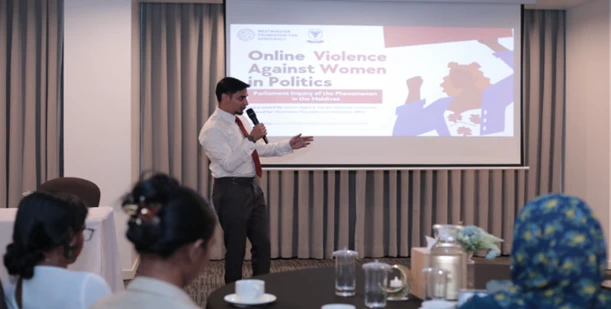
The comprehensive validation session featured expert contributions from Amish Abdullah and Dr. Fazeela Ibrahim representing Villa College, alongside Janet Veitch of the WFD. The forum brought together key legislative and executive figures, including representatives from the parliamentary committee, the Attorney General's Office, Transparency Maldives, the United Nations Development Programme (UNDP), various political parties, and key civil society stakeholders.
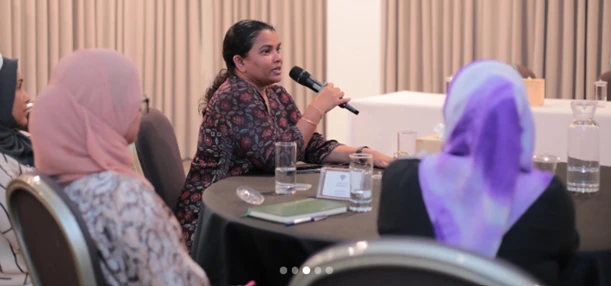
This collaborative engagement ensured that empirical research findings, legal analysis, and specialist technical perspectives directly informed parliamentary considerations regarding online harassment, legal safeguards, institutional responses, and the protection of women's political participation rights.
By seamlessly bridging academic analysis with active legislative inquiries, Villa College advanced evidence-informed government consultation, human rights protections, and the strengthening of inclusive democratic institutions across the Maldives.
Student-Led Research on Cybersecurity and Data Protection Governance
In October 2025, Villa College's Faculty of Shariah and Law (FSL), in collaboration with the Villa College Law Society (VCLS), secured a research project commissioned by the Westminster Foundation for Democracy (WFD), titled Empowering a Secure Digital Maldives: Student-Led Research on Policy and Legal Frameworks for Cybersecurity and Data Protection. The initiative marks an important step towards strengthening Villa College's contribution to evidence-based legal and policy research addressing emerging national challenges.
The project will be undertaken by law students under the academic supervision of Dr. Mohammad Shekaib Alam, Amish Abdullah, Mohd Arsh Shery and Uza Asna Ahmed. It will examine existing cybersecurity and data protection frameworks in the Maldives, identify legislative and institutional gaps, and undertake comparative analysis of international regulatory approaches. The research aims to develop policy recommendations that can support government authorities and policymakers in strengthening cybersecurity governance, personal data protection and institutional accountability. Through this initiative, Villa College seeks to contribute specialist legal expertise to future national policy discussions while encouraging meaningful student participation in policy-oriented research.
Technical Engagement with National Fisheries and Ocean Governance Institutions
Villa College significantly expanded its institutional contributions to national ocean governance, marine resource management, and international environmental compliance through the dedicated efforts of its Centre for Transformative Environmental and Marine Law (CTEM). Between 20 and 23 September 2025, CTEM actively participated in a high-level regional workshop on fisheries and ocean governance, engaging with a diverse coalition of international experts, national policymakers, and institutional stakeholders.
Building on this regional dialogue, the Centre contributed technical and legal expertise during a national fisheries workshop organized in close association with the Ministry of Fisheries and Ocean Resources and the United Nations Division for Ocean Affairs and the Law of the Sea (DOALOS). These technical forums provided vital platforms for addressing complex legal and regulatory challenges, including the enforcement of fisheries compliance, alignment with international maritime obligations, sustainable marine resource stewardship, and institutional capacity building.
Continuing Legislative and Government Collaboration
Villa College maintains a strategic, ongoing partnership with the People's Majlis Secretariat, anchored by a formal Memorandum of Understanding. This institutional framework establishes a structured foundation for multi-faceted collaboration in legislative research, parliamentary education, professional capacity building knowledge exchange, and public civic literacy. By connecting higher education directly with the national legislature, the partnership facilitates deep legal policy analysis, supports evidence-informed lawmaking, and strengthens public understanding of parliamentary processes.
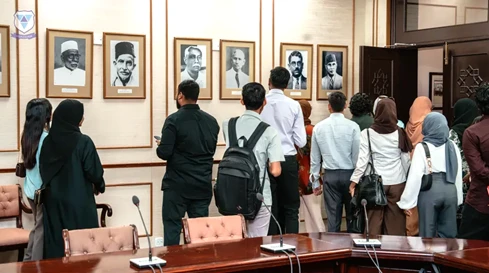
A primary operational milestone of this collaboration in 2025 was the execution of the comprehensive Parliamentary Education Programme. This immersive initiative enabled students to observe live floor proceedings of the People's Majlis, gain direct insight into democratic decision-making, access specialized legislative archives, and engage with senior secretariat officials.
Through this experiential learning model, participants developed an advanced practical understanding of constitutional duties, legislative drafting, statutory oversight, and the operational mechanisms of parliamentary committees. By systematically aligning academic coursework with active legislative environments, Villa College fosters constitutional literacy, enhances civic engagement, and reinforces its wider research and policy advisory contribution to national governance.