Inclusive Institutional Governance Through the College Council
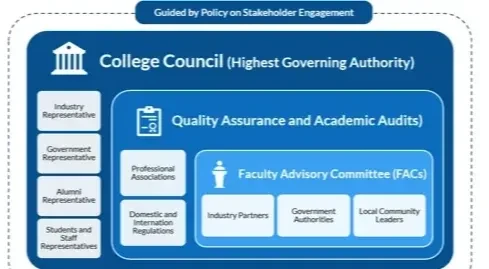
Villa College promotes transparent, participatory and inclusive institutional decision-making through its College Council, the highest governing body responsible for overseeing the strategic direction and institutional development of the College. The Council provides a formal mechanism for involving external local stakeholders, including representatives from government, industry and the wider community, alongside elected staff and student representatives.
The College's Governance and Stakeholder Engagement Framework incorporates two industry representatives and one government representative into its governing structure. Its published membership identifies Dr. Nadira Ismail (Civil Society Representatives), an education specialist and consultant with academic involvement at Mandhu College, and Mr. Thoha Saleem, Principal of Ghiyasuddin International School, as Industry Representatives. Dr. Ahmed Mohamed, Minister of State for Education at the Ministry of Education, serves as the Government Representative. Their participation brings perspectives from the education sector, professional educational practice and national government into the College's governance arrangements, providing a formal mechanism for external stakeholder input into strategic planning, institutional policies and decision-making processes.
Faculty Advisory Committees: Integrating Community and Professional Perspectives
Villa College further institutionalises external stakeholder participation in academic decision-making through Faculty Advisory Committees (FACs), which provide structured opportunities for government authorities, local residents, industry representatives, civil society organisations, professional bodies and community leaders to contribute to academic development. These committees support dialogue concerning curriculum relevance, workforce expectations, professional standards, student placements, learning resources and institutional quality assurance.
The College's established Faculty Advisory Committee framework draws upon representatives from healthcare, education, engineering, business, law and other professional sectors. Their involvement helps connect academic planning with the practical needs of employers, professional regulators and the communities served by Villa College. By incorporating external expertise into curriculum development and strategic academic discussions, these participatory bodies strengthen the responsiveness and relevance of the College's educational provision.
Local Government Participation in Regional Educational Development
Villa College strengthened its engagement with local government authorities, island communities and local residents through formal collaboration on regional higher education provision. On 7 May 2025, the College announced a Memorandum of Understanding with HA. Dhidhdhoo Council, establishing a collaborative framework for expanding access to tertiary education for island residents. Signed by Villa College Vice Rector Dr. Ali Najeeb and Council President Abdulla Rasheed, the five-year agreement provides for the Council to facilitate suitable educational premises, while Villa College undertakes academic delivery, management and quality assurance.

This arrangement illustrates how collaborating with an elected local council guides the practical execution of educational decisions to address regional needs. By establishing an ongoing coordination framework between Villa College and island authorities, the partnership enables locally tailored education, improved community access, and joint planning. Villa College also maintains council partnerships in Maafushi, Naifaru, and Hoarafushi, creating an institutional basis to involve local authorities in expanding higher education beyond Malé.
Government Participation in Education and Programme Development
On 6 August 2025, Villa College entered into a Memorandum of Understanding with the Ministry of Education, incorporating the College's Diploma in Teaching Primary and Special Educational Needs into the government's national teacher-training initiative. This collaboration connected Villa College's academic provision with public-sector priorities for inclusive education and professional teacher development. The agreement demonstrates institutional cooperation with a national government stakeholder in determining how an academic programme is delivered and funded. By responding to identified public education needs through a jointly supported training initiative, Villa College strengthened the relationship between academic planning, government priorities and community access to education.

Industry and Professional Association Participation in Institutional Development
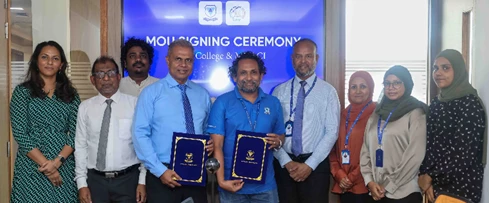
Villa College significantly expanded its strategic engagement with key industry leaders, professional associations, and major employers through several formal, multi-faceted partnerships throughout 2025. On 22 May 2025, the College signed a landmark Memorandum of Understanding with the Maldives National Association of Construction Industry, establishing a comprehensive platform for joint research, targeted human capital development, and continuous knowledge-sharing in areas of mutual interest. This strategic agreement provided a structured framework for institutional consultation with a primary sectoral association, ensuring academic offerings remain aligned with emerging infrastructure demands and industry standards.
Continuing this momentum, on 2 December 2025, Villa College entered into a transformative Memorandum of Understanding with Maldives Transport and Contracting Company Plc (MTCC). Designed to effectively bridge academia and industry, the agreement established jointly developed, industry-aligned training programmes, direct student internship pathways, facilitated access to major project sites for practical learning, and collaborative research initiatives addressing national transport and contracting challenges.
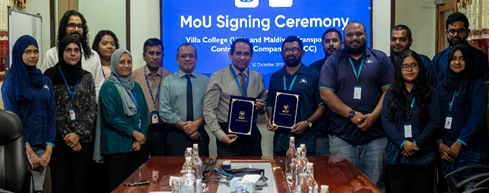
These comprehensive provisions institutionalise a continuous dialogue between academic faculties and industrial stakeholders, enhancing the overall design, relevance, and execution of professional learning opportunities.
Further strengthening its strategic linkages with the hospitality and tourism sector, Villa College signed a pivotal Memorandum of Understanding with Centara Hotels & Resorts on 16 December 2025. This alliance opened valuable pathways for student internships, immersive industry exposure, hands-on operational training, and long-term career development within a premier international hotel brand. Collectively, these strategic partnerships demonstrate Villa College’s sustained commitment to working alongside leading employers and professional bodies to deliver industry-responsive education, foster workforce development, and cultivate practical, career-ready skills.

Healthcare Stakeholder Engagement and Collaborative Academic Planning
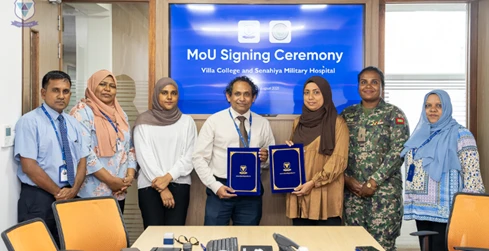
Villa College actively expanded and strengthened its strategic engagement with key healthcare institutions to support clinically relevant education, hands-on experiential training, and continuous professional development. On 27 August 2025, the College established a formal partnership by signing a Memorandum of Understanding with Senahiya Military Hospital, creating structured clinical placement opportunities and immersive practical learning experiences tailored for health sciences students.
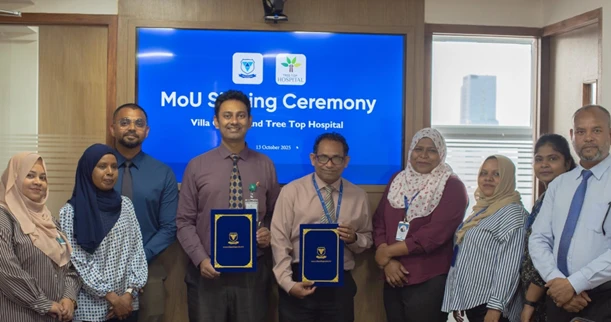
Furthermore, on 13 October 2025, Villa College and Tree Top Hospital signed an MoU to define collaborative arrangements and co-host the International Medical Education and Research Conference 2025. These strategic alliances established dedicated channels for healthcare professionals, clinical practitioners, and academic representatives to exchange domain expertise, advance joint research, and systematically align health education initiatives with current clinical demands.
Such ongoing collaborative engagements directly complement and enrich the College's formal advisory structures. By deepening institutional ties with professional health sector stakeholders, Villa College ensures that real-world clinical insights continuously inform curriculum relevance, rigorous professional standards, and practical training requirements across its health sciences programs.
Furthermore, these multi-faceted collaborations establish vital feedback loops where healthcare practitioners and academic leaders jointly refine educational delivery, incorporate evolving clinical competencies, and ensure students receive extensive experiential learning aligned with national public health priorities. Beyond updating program structures, this dynamic synergy enables healthcare practitioners to serve as clinical mentors, bringing real-time patient care insights and evidence-based methodologies directly into academic instruction. Concurrently, academic institutions utilize structured feedback from clinical partners to continuously evaluate learning outcomes, update curriculum benchmarks, and integrate emerging medical technologies into simulation laboratories and coursework. This reciprocal engagement ensures that theoretical frameworks are directly reinforced by structured practical training, addressing systemic workforce needs and equipping future healthcare professionals with the exact operational competencies required to address pressing community and public health challenges across the country.
Additional Partnerships Supporting Stakeholder-Responsive Education
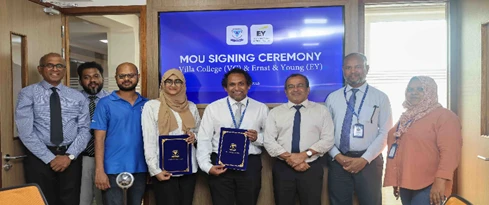
Other 2025 partnerships contributed to Villa College's engagement with professional and institutional stakeholders. On 24 April 2025, the College signed an MoU with EY Maldives, providing opportunities for student internships and professional awareness sessions in audit, tax and related fields.
In April 2025, the College also renewed its collaboration with Universal Resorts through an agreement supporting the Discover Hospitality programme, combining academic instruction with practical workplace training. These initiatives strengthened ongoing dialogue with employers and supported programmes responsive to workforce needs. While they provide supplementary evidence of external stakeholder collaboration, their contribution to participatory governance depends on evidence that the partners had an identifiable role in institutional planning, programme decisions or formal consultation processes.