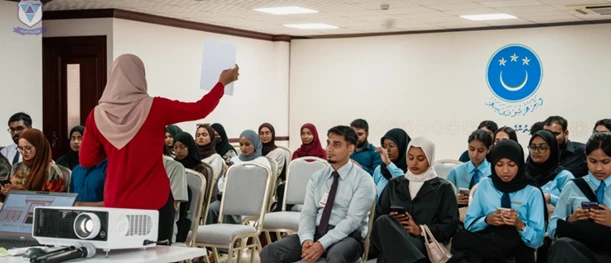
Outreach and Research Education for Parliamentary Personnel
On 31st August 2025, Villa College's Faculty of Shariah and Law delivered a Research Training Workshop for People's Majlis Staff and Committee Research Officers, providing specialised education and capacity-building directly to professionals supporting the national legislature. Conducted in collaboration with the People's Majlis Secretariat, the full-day programme focused on research methodologies relevant to parliamentary inquiries, legislative scrutiny and policy-oriented investigations. The workshop was facilitated by Dr. Tajudeen Sanni, Amish Abdullah from the Faculty of Shariah and Law establishing the significant differential design of literature review interacting with the policies and bills in Majlis. Dr. Mohammad Shekaib Alam, Mohd Arsh Shery and Dr. Nfor Nde Nyambi expanded the changing dimensions of integrated methodology in policy research. Participants received practical instruction on developing research questions, structuring legal research projects, conducting literature reviews and targeted desk reviews, and applying doctrinal, comparative, socio-legal and empirical research approaches. The programme also incorporated interactive exercises involving policy-related research scenarios, enabling parliamentary staff to consider how research evidence can be organised and applied when supporting legislative committees.
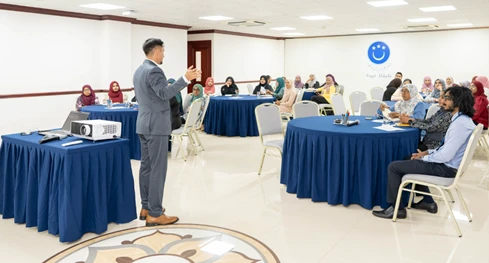
By directly engaging Committee Research Officers, legislative support personnel and parliamentary researchers, Villa College contributed to strengthening the analytical skills required for evidence-based lawmaking, parliamentary oversight, legislative research and informed public policy development. This initiative represents a direct institutional contribution to the continuing professional education of personnel involved in supporting democratic governance.
Capacity-Building for Public Accountability Institutions
Villa College's Institute for Research and Innovation, through its Corporate Training Division, conducted a Training of Trainers (ToT) programme from 21-23 January 2025 involving participants sponsored by the Auditor General's Office, an independent institution responsible for public financial accountability and audit oversight in the Maldives. The programme provided professional upskilling in training-related competencies that can support the internal dissemination of knowledge, professional development and continuing education within public institutions. Such capacity-building is relevant to strengthening institutional learning and the ability of public accountability organisations to maintain and develop professional competencies. By extending training opportunities to personnel from a national oversight body, Villa College supported the wider objective of professional capacity-building within public administration and accountable institutions.
Professional Upskilling for Government Personnel
Villa College delivered a Project Management training programme from 19-24 April 2025, involving staff sponsored by the Ministry of Dhivehi Language, Culture and Heritage and Housing Development Finance Corporation. The training provided opportunities to strengthen professional competencies in project planning, coordination and implementation. These capabilities are relevant to government institutions responsible for developing and administering cultural, language and heritage initiatives, where effective project management can support coordination, resource management and the delivery of public programmes. The inclusion of ministry personnel illustrates Villa College's contribution to professional education and institutional capacity-building within national government administration.
Leadership Capacity-Building for Law-Enforcement Personnel
Villa College conducted a Leadership Skills training programme involving personnel from the Maldives Police Service, alongside participants from the Housing Development Finance Corporation and the general public from 15 and 19 June 2025. The programme supported professional development in leadership and organisational management, which are relevant to the effective functioning of public institutions. For law-enforcement organisations, leadership competencies can contribute to internal coordination, staff supervision, professional accountability and effective administration. By providing structured professional development to personnel serving within the national police institution, Villa College contributed to the broader capacity-building environment supporting effective public administration, institutional leadership and responsible governance.
Leadership and Ethics Capacity-Building for Local Institutions
On 12 and 15 July 2025, Villa College delivered Effective Leadership and Work Ethics training for K. Maafushi Local Authority Company Ltd. a public authority. The training addressed leadership and ethical workplace conduct, both of which are relevant to the administration and delivery of services by organisations operating within local communities. Such capacity-building can support clearer professional responsibilities, effective supervision and responsible organisational practices. This initiative demonstrates Villa College's engagement in locally relevant leadership education and institutional workforce development.
Technology and Data Upskilling for Public-Facing Institutions
Villa College also delivered targeted professional upskilling in analytical and administrative competencies essential for effective institutional management and evidence-based decision-making. From 18 to 21 May 2025, the College facilitated an Intermediate Microsoft Excel course for 25 professionals from the Maldives Monetary Authority Training Institute. This capacity-building initiative enhanced spreadsheet-based analytical and data management capabilities, directly supporting robust reporting and operational decision-making within national financial-sector bodies.
On 1 and 2 September 2025, the College conducted specialized Data Modelling and Visualisation training for 25 staff members sponsored by the Housing Development Corporation. The workshop focused on interpreting and presenting complex operational metrics, strengthening the capacity of public institutions to communicate insights clearly and optimize data for administrative oversight.
Further institutional upskilling was delivered to personnel from the Housing Development Finance Corporation (HDFC) through three additional programmes. From 24 to 29 May 2025, Villa College successfully organized and delivered a specialized Intermediate-to-Advanced Microsoft Excel training programme tailored specifically for 21 key personnel from the Housing Development Finance Corporation (HDFC). Designed to advance institutional technical capacity, the intensive hands-on curriculum covered advanced data modeling, complex statistical formulas, automated workflow functions, analytical dashboards, and structured database management. By upgrading these core computational competencies, the training directly empowered participants to streamline institutional reporting mechanisms, optimize financial data processing, and elevate the overall rigor and speed of professional decision-making within the organization.
Building on this professional capacity-building series, on 2 August 2025, the College conducted a comprehensive Customer Service Excellence training workshop for 21 HDFC employees. The program targeted frontline service personnel and client relations teams, focusing on modern service standards, active listening, conflict resolution strategies, empathetic client engagement, and effective communication channels. This initiative equipped staff members with practical tools to elevate service touchpoints, resolve complex client inquiries efficiently, foster stronger stakeholder relations, and maintain public trust in institutional service delivery.
To complete the upskilling track, Villa College facilitated an Effective Communication Skills workshop on 9 August 2025, which brought together 24 participants from HDFC. The interactive training focused on workplace interpersonal dynamics, inter-departmental collaboration, assertive verbal and written communication techniques, and collaborative problem-solving. By strengthening these fundamental workplace competencies, the course successfully fostered enhanced team synergy, reduced communication friction across organizational tiers, and established a more aligned, responsive, and efficient working environment.
These activities complemented the College's wider technology, communication and professional upskilling initiatives, contributing to staff development and organisational capacity in a public-facing financial institution.
Research Education and Skills Development for Institutional Personnel
On 18 October 2025, Villa College delivered a specialized Writing Research Plan training programme organized in collaboration with the JICE–JDS Project Office in the Maldives. The initiative offered practical instruction in structuring research proposals, defining methodologies, and managing research projects effectively. Such skills directly reinforce institutional research capacity and evidence gathering, particularly within public-sector scholarship frameworks and state-supported educational programs. This activity complemented the College’s broader academic outreach, advancing critical analytical and research-design competencies among key professional cohorts.
General Legal Education and Professional Upskilling
Villa College’s executive education initiatives further advanced legal literacy, professional competencies, and access to continuing legal learning throughout 2025. Through its Faculty of Shariah and Law, the College organized two hybrid Court Practice training modules designed to enhance practical litigation skills and deepen understanding of judicial processes. The inaugural module took place on 1, 2, and 9 August 2025, featuring 10 hours of intensive instruction led by Uz. Abdulla Mifraz Nizar. A subsequent 16-hour advanced module, facilitated by Uz. Abdulla Ali, Resident Judge at Villa College, was conducted across 24–25 October and 31 October–1 November 2025.
Together, these modules reflect the institution's commitment to delivering structured legal upskilling and professional development alongside standard degree pathways. These targeted offerings complement Villa College’s ongoing engagement with the justice sector by providing practical training in courtroom advocacy. Their broader impact on policy- and lawmaker education remains tied to the active participation of state legal officers, court administrators, parliamentary researchers, and public decision-makers.
Additional Legal Awareness and Educational Outreach
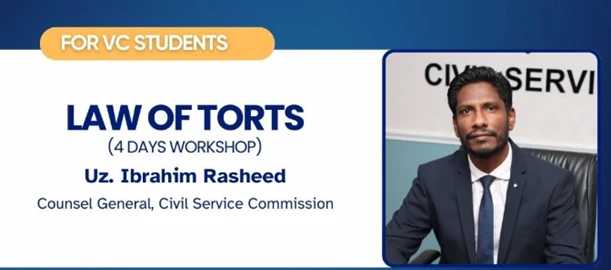
Villa College's broader engagement in legal education, public awareness and professional development complemented its government-facing capacity-building activities. On 23 August 2025, the Faculty of Shariah and Law conducted a Bar Examination preparation workshop with Counsel General Uz. Ibrahim Rasheed, strengthening candidates' understanding of the Law of Torts and professional examination requirements.
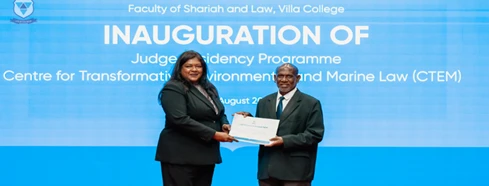
On 26 August 2025, Villa College launched its landmark Judges Residency Programme, establishing a formal and structured institutional mechanism to integrate extensive judicial experience directly into higher legal education, student mentorship, and policy-oriented legal research. Designed to bridge the gap between academic theory and judicial practice, the initiative brings sitting and former judges into the academic environment to share practical insights into litigation, statutory interpretation, judicial decision-making, and court procedures. Through interactive seminars, guest lectures, specialized workshops, and research collaborations, the programme enhances students' practical litigation competencies and critical legal analysis while fostering meaningful dialogue between the legal academia and the judiciary.
Further initiatives included the Parliamentary Education Programme for Students, legal-aid training and outreach programmes involving Transparency Maldives, and the Street Law sessions conducted for school students. Together, these activities supported civic education, legal awareness, professional development and public understanding of justice institutions.